Stamp cards, without the paper.
The buy-nine-get-one mechanic that's worked in every café for forty years — but the card lives in Apple Wallet or Google Wallet instead of crumpled at the bottom of a tote bag.
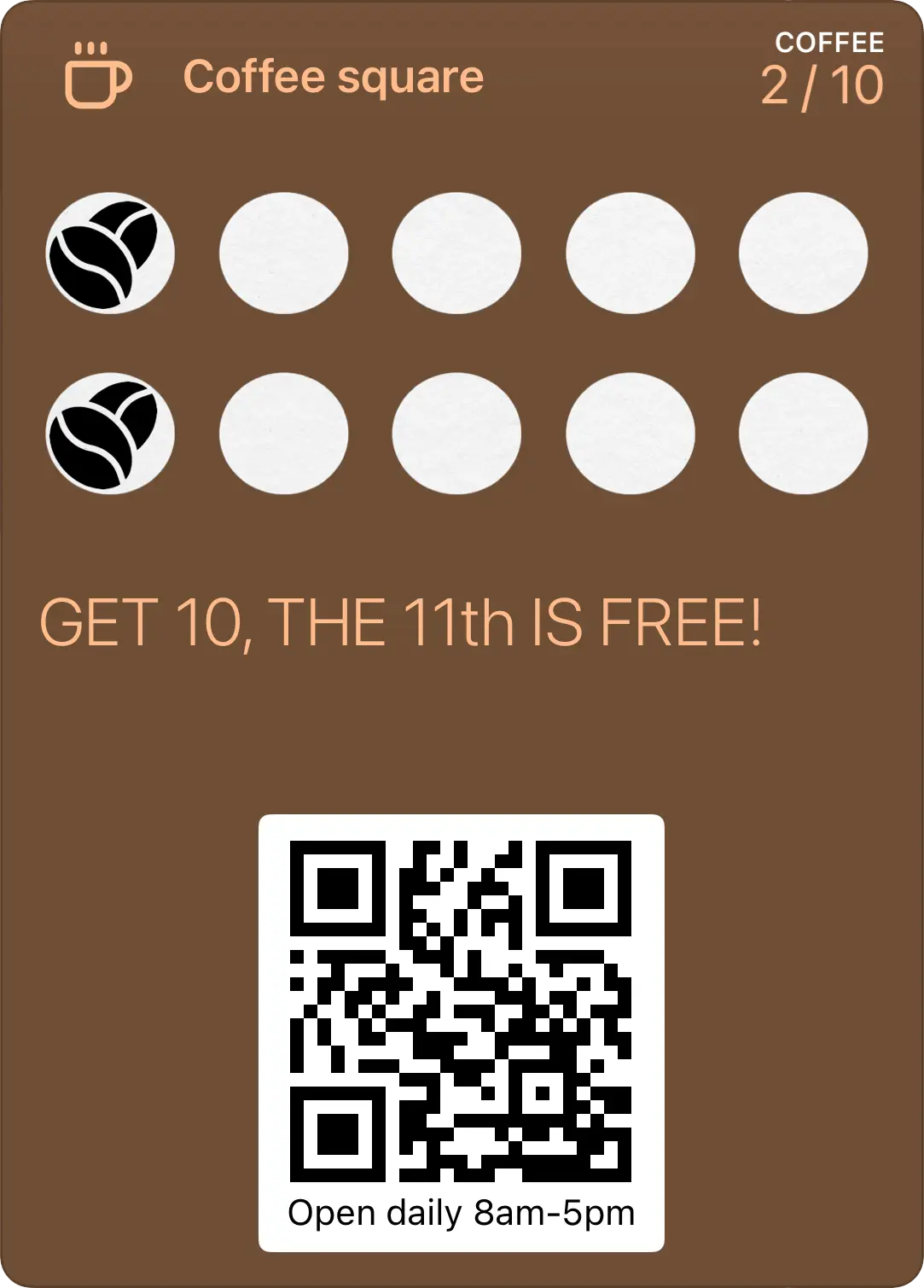


The problem isn't the stamp card. It's the paper.
Walk into any half-decent café and there's a stack of stamp cards by the till. They work. People come back for the tenth coffee they don't have to pay for. The card itself is one of the most reliable pieces of behavioural design in retail.
Now ask the owner what their redemption rate is. They don't know.
Ask how many cards they printed last quarter. They might know.
Ask how many were filled and redeemed. They definitely don't know.
The card works as a mechanic but fails as a tool. You can't see it after the customer leaves the counter. You can't message a customer to tell them they're one stamp from a free coffee. You can't tell whether your stamp card is doing anything at all — you just trust that it is, because everyone else has one, and reprinting another batch costs €40.
The digital version isn't trying to replace the idea of a stamp card. It's trying to fix the parts of the paper one that have been quietly broken the whole time.
What "digital" actually means here.
The card lives in the wallet app that's already on the customer's phone. On an iPhone, that's Apple Wallet — the same place their boarding passes and credit cards live. On Android, it's Google Wallet. Both apps are pre-installed. The customer doesn't download anything new. They tap a link or scan a QR code and the card slides into their wallet in about eight seconds.
When they buy something at your shop, you open the scanner on your phone, point it at the QR code on their card, and a stamp lands. They feel the phone buzz. They glance at the lock screen as they walk out.
That's the whole loop. No iPad on the counter. No barcode reader. No POS integration. Your phone scans their phone.
What changes the day you switch.
Six things change in concrete, observable ways. None of them are theoretical.
You stop reprinting.
The €40 you spent every two months on a fresh stack of cards from the printer becomes €0. The art file on the printer's hard drive becomes irrelevant.
The card stops getting lost.
Customers don't carry the same wallet every day. They do carry the same phone every day.
You can change the offer on Tuesday.
Decided ten stamps is too many and you want to test eight? Change one number in the dashboard. Every customer's card updates inside their wallet within the hour. You don't reprint, you don't apologise to the half-full cards, you don't run two programmes in parallel. You just change the number.
The lock screen becomes a free advertising channel — sparingly.
A customer walks past your shop on the way home from work. Their card pings on the lock screen: "Lovely Local Café — 8/10 stamps." You didn't pay for that. You don't get to do it constantly, and you shouldn't — the same way you shouldn't text every regular every Friday. But twice a month, used well, it's worth more than a postcard.
You can finally see what the programme is doing.
Cards issued this week. Stamps added today. Reward redemptions this month. Whether your Saturday morning regular has been in once or four times. This is the most boring-sounding upgrade and the most useful one.
Nobody can rubber-stamp themselves at home.
This sounds like a joke until you have a small café and realise you genuinely can't tell whether the half-full card someone slid across the counter was stamped by you or by their flatmate with a craft stamp from the bookshop.
A few real scenes.
The bakery on a Tuesday morning.
The owner has run a paper card for years. Buy six bread loaves, get the seventh free. She prints them on cream cardstock — it matches the awning. She has no idea what the redemption rate is. She knows roughly how many people are regulars because she recognises their faces. She switches to digital not because she's chasing analytics, but because she's tired of the box of half-stamped cards customers have abandoned on the counter. Three months later she notices her dashboard shows 340 active cards. She didn't know she had 340 regulars. She uses the push notification feature exactly twice that quarter — once to announce a Saturday opening, once to say sourdough is back. Both work.
The barber's first Friday.
He sets up the card in the chair between appointments, on his phone, using the bathroom break of the guy in seat one. Six haircuts for a free seventh. He prints the QR sticker that night on his home printer and tapes it next to the mirror. The first person who scans it is a customer who's been coming for two years. The customer says "ah, finally" and means it.
The pizza place that almost didn't bother.
The owner thinks loyalty cards are for cafés, not for him. Average ticket is €18. He runs the maths: tenth pizza free is a ~10% discount on a regular who'd come back anyway. He sets it up reluctantly. What he doesn't expect is the lock-screen ping. Two months in, he can see in the dashboard that customers within walking distance of the shop are opening the card on the lock screen on Friday evenings. He starts sending one push a week — "fresh dough until 11" — and his Friday late-evening covers go up. The free pizza is now the cheapest marketing line on his books.
The honest comparison.
| Paper | Digital | |
|---|---|---|
| Cost per card | Printing cost | Free |
| Customer carries it | Only if they remember | Always — it's on their phone |
| Can be lost | Yes | No |
| Can be faked | Yes | No |
| Can you message the customer later? | No | Yes — push notifications |
| Updates after printing | Reprint everything | Instant |
| Analytics | Guesswork | Real-time dashboard |
| Setup time | Order from a printer | 5 minutes |
The one thing paper has going for it: the physical object. A nicely designed card on heavy stock feels like something. A digital card in a wallet app feels like a digital card in a wallet app. If the texture of the card is part of how customers experience your shop — a fine-dining restaurant, a high-end florist — keep the paper version too. The two are not mutually exclusive. Most shops, though, are not selling the card. They're selling the tenth coffee.
What we won't tell you.
A digital stamp card will not turn a quiet shop into a busy one. If people aren't coming back, the reason is almost always something other than the card. The coffee is fine but not memorable. The neighbourhood is changing. The hours are wrong. The card amplifies what's already working — it does not manufacture loyalty out of thin air. We've watched people sign up expecting magic and we'd rather you go in with eye contact.
The shops that get the most out of this are the ones who already have regulars and want to reward them properly. If that's you, this works.
And a stamp card isn't the right loyalty card for every shop. If your customers visit twice a year instead of twice a week, or your shop is more of a gifting business, a coupon or gift card may fit better — our loyalty cards guide walks through which kind fits which shop.
Setup, honestly.
You sign up. You upload a logo. You pick two colours. You decide the reward (ten coffees, six haircuts, whatever). You hit publish. That's the five-minute claim, and it's accurate for most shops — designers don't take five minutes because they want to fiddle with everything, which is fair.
You print the QR sticker (we send you a print-ready PDF) and tape it somewhere visible at the counter. You tell your staff: when a customer wants a stamp, open the app, scan, done. Most owners train their staff in the time it takes to make a flat white.
If you want help, write to us. A real person answers, usually within hours, in English or German. We're three humans in Berlin, not a help desk in another timezone.
€10 a month for your first 250 cards.
€20/month for 500. €50/month for 1,500. Every plan includes every card type, every feature, unlimited templates, push notifications, analytics, and same-day human support — there is no enterprise tier hiding the good stuff. 14 days free. 45-day money-back guarantee if you change your mind.
Questions people actually ask.
Straight answers, no marketing fluff.